Disclosure: This post contains affiliate links. If you buy through a link on this page, we may earn a small commission at no extra cost to you.
The mask, jacket, and weapon get all the attention — and all the budget. Then your child walks into their first competition and gets stopped at equipment check because nobody told you a spare body cord was required, or they fence three bouts in socks that keep sliding into their shoes. The big items get your child onto the strip. The small items, most of them under $25, are what keep the day from falling apart.
Here is the full list of easy-to-forget accessories, sorted into what is genuinely required, what is strongly recommended, and what is simply nice to have — with honest prices.
Must-Have: Rules and Equipment Check Will Catch These
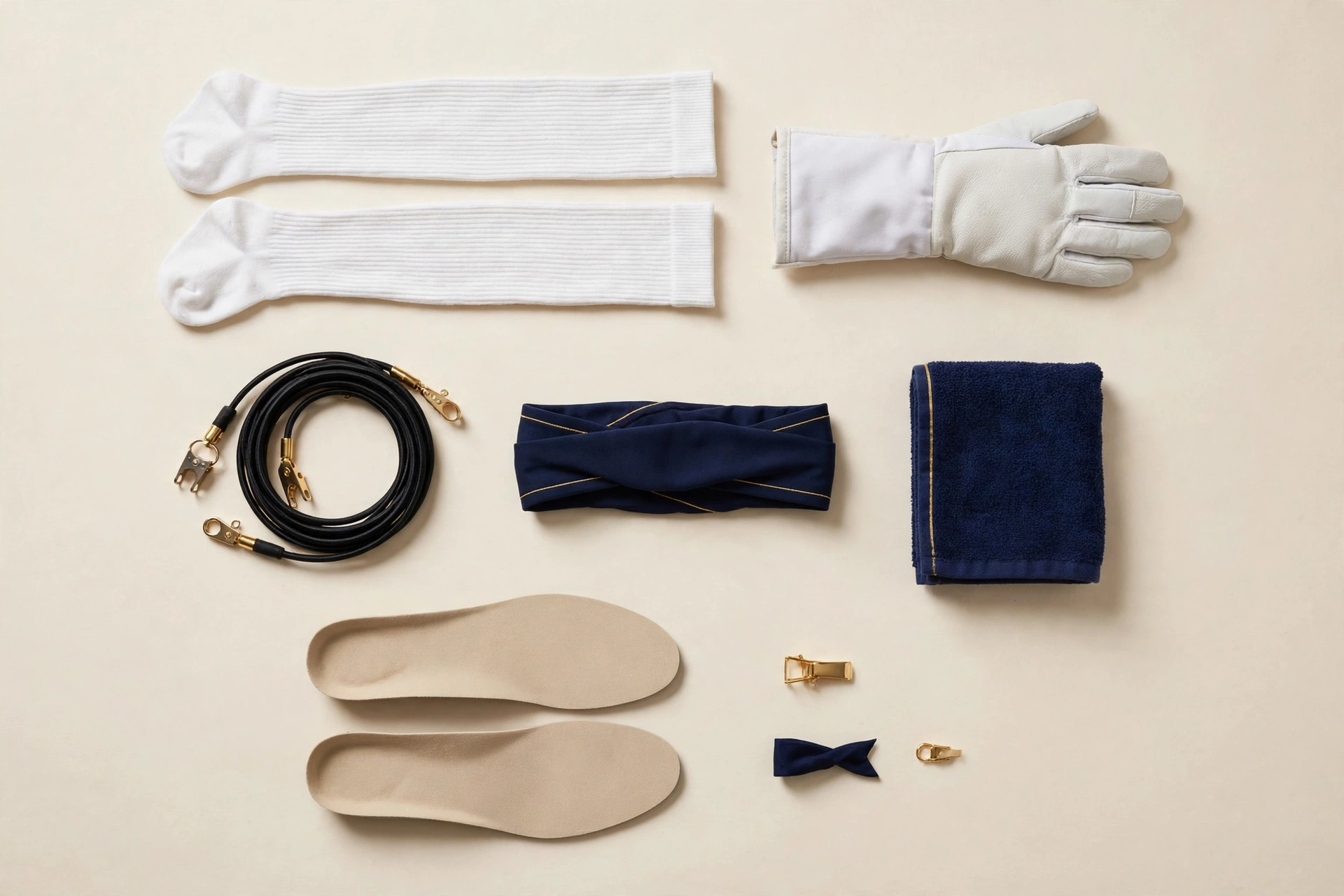
Long socks that reach over the knee — buy at least two pairs. This is a rule, not a fashion choice. Fencing knickers end just below the knee, and the socks must meet them so no bare skin shows on the leg. Competition officials do check. Any plain over-the-knee sports sock works — it does not have to say “fencing” on the package — but purpose-made fencing socks add padding on the shin, where hits land. About $10–25 a pair. Check price on Amazon
A spare body cord. Body cords are the most failure-prone item in the whole kit: the wires fatigue inside the plug and a cord that worked on Tuesday fails at Saturday’s check-in. Sanctioned competitions expect you to have working spares at the strip, and “my only cord just died” is not an excuse a referee can accept. Buy one spare per weapon your child fences, and match the plug type — two-prong for foil and saber, three-prong (or the bayonet style) for epee. About $15–25. Check price on Amazon
A mask cord (foil and saber only). This short cord clips the mask to the lamé so the mask counts as part of the target. Epee fencers do not need one. Foil and saber fencers need one that works, and a spare is cheap insurance because the alligator clips bend and break. About $8–15. Check price on Amazon
Recommended: Small Money, Big Difference
A spare glove. Gloves get lost, left at the club, and soaked through with sweat — and a fencer cannot fence without one. A basic washable glove is also the single most replaced item in youth fencing, so the “spare” usually becomes the main glove within a season. About $20–35. Check price on Amazon
A moisture-wicking underlayer (top, and bottoms in winter). A thin athletic tee under the jacket does three jobs: it keeps scratchy seams and labels off the skin, it soaks up sweat before the jacket does, and it makes a shared or rented jacket feel a lot more hygienic. Long compression leggings under the knickers do the same for legs and add warmth in cold venues. Any sports brand works. About $15–35 per piece. Check price on Amazon
A sweatband or sports headband. Sweat running into the eyes under a mask is miserable, and a fencer cannot wipe their face mid-bout. A simple headband worn under the mask catches most of it. Thin is better — thick bands change how the mask sits. About $8–15 for a multi-pack. Check price on Amazon
Athletic tape and blister supplies. One roll of sports tape plus a few blister plasters covers the three classic small emergencies: a hot spot on the heel, a grip that needs a quick wrap, and tape over a sharp edge or a loose plug. About $5–20 depending on what you bundle. Check price on Amazon
Heel cups or cushioned insoles. Fencing is lunging on a hard floor, and growing feet take the impact. Gel heel cups are a cheap first step for heel soreness in practice shoes; structured support insoles cost more but last longer. About $15–20 for heel cups; about $45–65 for a structured insole pair. Check price on Amazon
Optional but Nice
Charcoal deodorizer bags for the gear bag. Drop one in the fencing bag and one in each shoe after practice. They will not perform miracles on a bag that never gets aired out, but they noticeably slow down the famous fencing-bag smell. About $10–20 for a multi-pack. Check price on Amazon
A small towel and a spare hair tie. The towel is for the fencer, the hair tie is because one always snaps at the worst moment. Costs almost nothing; lives permanently in the bag.
The Night-Before Checklist
Print this, tape it inside the bag lid, and run it the night before every competition — not in the parking lot:
- ☐ Mask (with mask cord attached, foil/saber)
- ☐ Jacket, plastron, knickers, chest protector if worn
- ☐ Two working weapons
- ☐ Two body cords — tested, not just packed
- ☐ Spare mask cord (foil/saber)
- ☐ Glove, plus the spare glove
- ☐ Two pairs of over-the-knee socks
- ☐ Underlayer top, headband
- ☐ Shoes with tape and blister plasters in the pocket
- ☐ Water bottle, towel, hair ties
FAQ
Can my child just wear soccer socks?
Usually yes — what matters is the length (over the knee, meeting the knickers) and that they stay up. Padded fencing socks are more comfortable against hits on the shin, but a tall soccer sock passes check.
How many body cords does a competitor actually need?
Two working cords is the practical minimum at a sanctioned event: the one in use and a spare at the strip. Test both the night before — a cord can look perfect and still fail.
Do epee fencers need a mask cord?
No. Mask cords are for foil and saber, where the mask is part of the electric target. Epee does not use one.
The Bottom Line
The must-haves — long socks, a spare body cord, and a foil/saber mask cord — add up to roughly $35–65 and prevent the three most common “we drove two hours for this?” moments in youth fencing. Add a spare glove and an underlayer and the bag is genuinely competition-ready. None of it is exciting, and all of it is cheaper than the gas to drive home early.