Disclosure: This post contains affiliate links. If you buy through a link on this page, we may earn a small commission at no extra cost to you.
“My mask digs into my forehead.” “The jacket itches.” “My heel is killing me.” Nearly every fencing parent hears some version of this in the first season — and the instinct is either to buy something new or to tell the child to tough it out. Both are usually wrong. Most gear discomfort has a small, cheap cause: a label, a soap residue, a sock that is too thin, a strap adjusted badly. And a few complaints are the gear telling you the size is simply wrong, which no amount of padding will fix.
Work through the complaint below, in order — try the first fix, then the next — and use the “wrong size” signals at the end to know when to stop adjusting and start exchanging.
Itchy and Scratchy: Jacket, Plastron, Lamé
First try: wash the itch out. A surprising share of “this fabric hates my skin” is leftover detergent or fabric softener in the weave, especially in brand-new gear. Run the jacket and knickers through one extra rinse cycle with no soap at all, then wash going forward with a small amount of fragrance-free detergent and no fabric softener (softener also degrades the fabric over time). Air-dry.
Then try: remove the offenders. Check for scratchy care labels at the neck and waist, and rough seam ends under the arms. Labels can be trimmed flush; a seam that rubs can be covered with a small patch of athletic tape as a test.
Then try: put a layer in between. A thin moisture-wicking underlayer tee solves most remaining cases — it moves the seams and edges off bare skin entirely. About $15–35. Check price on Amazon
Hot and Stuffy: The Mask and the “I Can’t Breathe” Complaint
Some heat is normal — a mask is a metal cage worn during hard exercise. But check the simple things first.
First try: clean or swap the mask lining. Many masks have removable padding that absorbs sweat and, after a month of practices, holds it. Wash the liner (or replace it if the brand sells spares) and the “stuffy” complaint often drops with the smell.
Then try: a thin sweatband under the mask. It keeps sweat out of the eyes, which is what kids usually mean by “I can’t see/breathe.” Keep it thin so it does not change the fit. About $8–15. Check price on Amazon
Then build the habit: mask off and water at every break, never “one more bout” in a row on a hot day. If your child regularly comes off the strip dizzy or with a headache, that is not a gear problem to solve at home — raise it with the coach and, if it persists, a doctor.
Rubbing and Blisters: Feet
Foot rubbing has three usual causes — shoe size, sock, and lacing — in that order of expense, so start free.
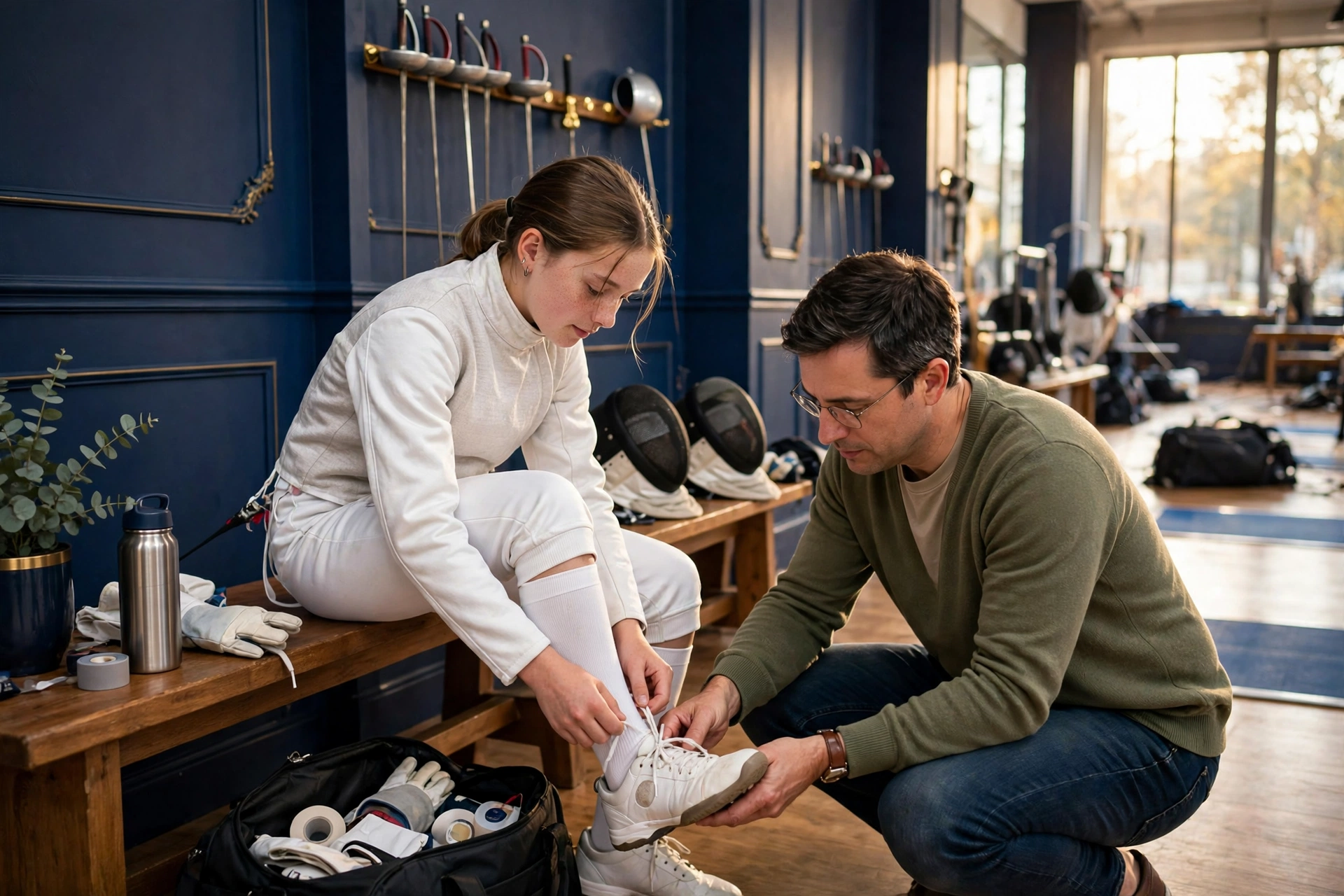
First try: lace for a heel lock. If the heel slips up and down (you can hear it), use the extra top eyelet on court shoes to make a runner’s loop and snug the heel into the back of the shoe. Slipping heel, not the shoe itself, causes most heel blisters.
Then try: change the sock. A thicker padded fencing sock (about $10–25) fixes rubbing caused by too much room; a thinner sock fixes rubbing in a snug shoe. Tape the hot spot or use a blister plaster for the session while you test. Check price on Amazon
Then try: heel cups for sore heels. If the complaint is heel pain from impact rather than skin rubbing, gel heel cups inside the shoe are the standard first step, about $15–20. Check price on Amazon
The too-small signal: toes that jam the front of the shoe on every lunge, or toenails that come home sore or blackened. Shoes do not “break in” out of being too short. That pair is done — size up. A half size of growing room is fine for training shoes; length that lets the foot slide is not.
Pressure Points: Mask, Chest Protector, Glove
Mask pressing on the forehead or chin. First, adjust before you accuse the size: loosen the back strap, reseat the mask so the chin rests in the chin pad, and bend the metal tongue at the back gently so it follows the head. Many masks can also be shaped slightly wider or narrower by hand at the sides. Then run the standard fit checks: with the mask on, your child shakes their head — the mask should not slide or wobble on its own; press the mesh lightly — it should not touch the nose; open the mouth — the jaw should not be jammed hard against the chin pad. A mask that fails those checks after adjustment is the wrong size, whatever the box said. Re-measure the vertical loop (under the chin, over the top of the head) and compare it against that brand’s chart in our size guide — brands disagree by a full size.
Chest protector edges digging in. Check placement first: the protector sits under the plastron, and for foil it needs its soft covering over it. Try it one size or one strap adjustment at a time, and have her do practice lunges in it — edges that are fine standing still dig in at full extension. Persistent digging at the underarm or collarbone after refitting usually means the shape or size is wrong for her; a different style (hard vs. soft) often fits better than the same style in another size.
Glove rubbing at the thumb webbing. The fold between thumb and index finger takes the grip’s pressure. A small piece of athletic tape or a finger sleeve over the spot works for a session; gel or padded glove liners help longer-term. But if the glove is so tight across the palm that the hand tires, or so loose the grip rotates inside it, that is a sizing problem — gloves are sized by hand measurement, and a replacement is only about $20–35. Check price on Amazon
Wrong Size, Not “Needs Breaking In”: Exchange It If You See These
- The mask slides when your child shakes their head, even with straps properly fastened
- A red pressure mark on the forehead or chin that is still there half an hour after practice
- Toes hitting the front of the shoe, or sore/blackened toenails
- A jacket your child cannot raise their sword arm in without the whole jacket riding up
- Numbness or tingling anywhere — hand, foot, or face — during or after fencing
- A complaint that is in exactly the same spot, every session, after you have tried the fixes above
When It Is Not a Gear Problem
This guide is about ordinary discomfort, not pain with a cause worth diagnosing. Stop and get proper advice — coach first, then a doctor — if foot or heel pain lasts more than a few days, if pain changes how your child walks, if there is swelling, or if headaches or dizziness keep happening on the strip. Growing athletes get real overuse injuries; no article (including this one) can tell the difference from the bleachers.
The Bottom Line
Rinse the detergent out, fix the lacing, add the underlayer, adjust the straps — in that order, most complaints die for under $20. What is left after those steps is usually a true size problem, and the right move is an exchange, not endurance.