Disclosure: This post contains affiliate links. If you buy through a link on this page, we may earn a small commission at no extra cost to you.
Every fencing parent knows the smell. It lives in the bag, it survives the car ride home, and by mid-season it seems to be coming from the gear itself. The good news is that almost all fencing gear can be washed. The catch is that each piece washes differently — and the two most expensive mistakes are throwing the lamé in the washing machine and putting anything in the dryer. This guide goes piece by piece.
The Golden Rules, on One Table
| Item | How to wash | Dryer? |
|---|---|---|
| Jacket, knickers, plastron | Machine wash cold, gentle — or hand wash | No — air dry |
| Plastic chest protector | Wipe down or rinse; straps hand wash | No |
| Mask | Removable liner/bib hand wash; mesh wiped or rinsed* | No — air dry fully |
| Lamé (electric jacket) | Wipe or gentle hand rinse only, never soak | Never |
| Glove | Hand wash lukewarm (check the label) | No — air dry |
| Shoes | Air out, insoles out; deodorize | No |
*Only fully rinse a mask if the mesh is stainless steel and the brand allows it — when in doubt, wipe instead, and always check the care label first.
Three rules apply to everything: cold or lukewarm water, mild detergent, no bleach and no fabric softener. Bleach and harsh detergents attack the fibers that give protective gear its puncture resistance, and fabric softener leaves a coating on everything, including conductive fabric. When a brand’s care label says something different from this page, the label wins.
The Uniform: Jacket, Knickers, and Plastron
The white uniform is the easiest part, and the part parents most often damage with heat.
- Close everything first. Zip the jacket shut and press every Velcro strap closed before it goes in the wash. Open Velcro shreds other fabrics and comes back full of lint, and an open zipper snags.
- Cold water, gentle cycle, mild detergent. A regular cold wash is fine for most modern 350N and 800N uniforms. Turn pieces inside out if sweat staining is heavy.
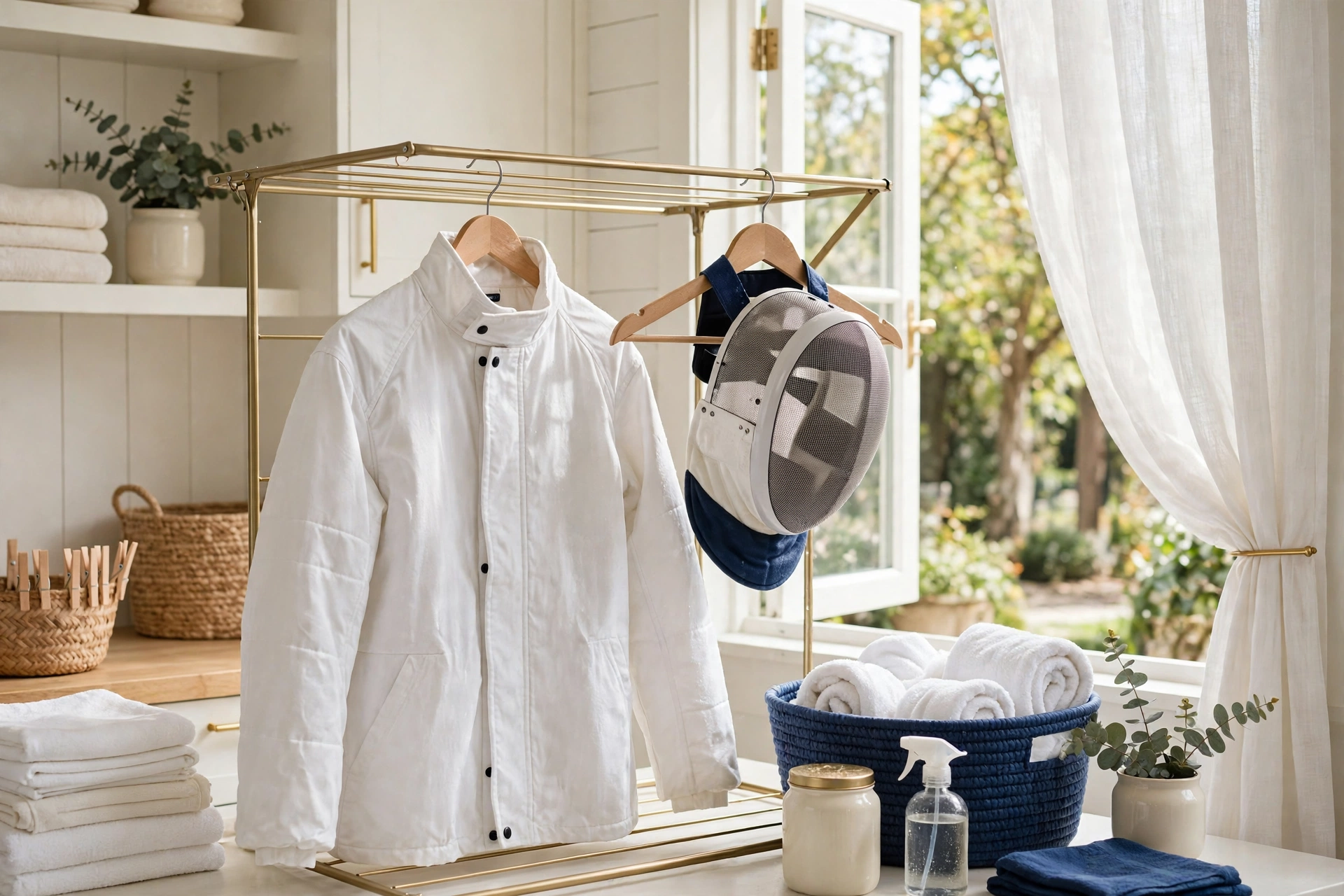
- Air dry, always. Hang pieces on a hanger or rack. The dryer is the enemy twice over: heat shrinks the fit your child was measured for, and repeated high heat degrades the synthetic fibers the protection rating depends on. Air-dried whites are ready the next day; plan backward from practice.
The plastic chest protector itself just needs a wipe or a rinse — it’s the elastic straps that hold sweat, and those can be hand washed with the rest.
The Mask: Wash the Liner, Respect the Mesh
A mask is two things: a steel mesh shell and soft parts that touch the face. They clean differently.
- Removable padding and bib: Many modern masks have a removable liner, and foil/saber bibs often detach. Take them out and hand wash in a sink of lukewarm water with a little mild detergent, rinse well, and air dry. Manufacturer instructions for removable padding generally say exactly this: hand wash cool, mild soap, no spin, no tumble dry.
- The mask itself: If the mesh is stainless steel, a gentle rinse or a dunk in soapy water followed by a thorough rinse is a well-established method — dry it completely afterward, with airflow, so nothing stays damp in the padding. If the mesh is painted or you’re not sure what it’s made of, don’t soak it: wipe inside and out with a damp cloth instead. Rust on a mask is not cosmetic; a mesh you can’t identify is a mask you wipe.
- Never machine wash a mask, and skip the dishwasher tricks you may find online — aggressive dishwasher detergents can damage coatings and bib fabric.
- Drying matters as much as washing. A mask put away while still damp will smell worse than it did before you washed it. Leave it somewhere air moves until the padding is dry all the way through — overnight at minimum.
Between washes, the biggest favor you can do a mask is to take it out of the bag when you get home. Most mask odor is just trapped moisture from being zipped in a bag for two days.
The Lamé: Wipe, Never Soak
The lamé — the shiny conductive jacket for foil and saber — is the one item that standard laundry advice will destroy. Its fabric is woven with metal threads, and those threads oxidize, break, and develop “dead spots” that fail equipment checks.
- Do not machine wash it. Do not soak it. Both are the classic ways lamés die.
- Routine care: after practice, hang it up to air. For actual dirt, wipe with a cloth dampened with lukewarm water and the smallest amount of mild detergent, then wipe again with plain water and hang to dry on a wide hanger.
- Never wring it, fold it sharply, or crumple it in the bag. Hang it or roll it loosely. The metal threads fatigue exactly where the fabric is creased.
- Sweat is the slow enemy. Salt left in the fabric corrodes the threads over a season, which is why a quick wipe after a sweaty tournament day — not a wash, just a wipe — genuinely extends a lamé’s life.
The same wipe-don’t-soak rule covers the conductive mask bib and the saber glove cuff: they’re the same kind of fabric.
Gloves, Shoes, and the Bag Itself
Gloves absorb more sweat than anything else your child owns. Most fencing gloves can be hand washed in lukewarm water with mild soap (leather gloves: follow the label or use leather-appropriate care), then air dried away from heaters — heat makes gloves stiff and cracked. A glove that still smells after washing and full drying is usually just worn out; gloves are a consumable.
Shoes shouldn’t be machine washed. Pull the insoles out after practice, open the shoes up, and let them dry completely. A sprinkle of baking soda overnight, shaken out in the morning, or an odor spray handles most of the rest.
The bag is where the smell actually lives. Empty it fully every week or two, shake it out, leave it open in the garage or laundry room overnight, and wipe the inside if it’s grimy. Gear stored in a clean, dry bag stays fresher far longer — and never, ever leave wet gear zipped inside it between practices. If you do only one thing in this entire article, do that.
How Often — and the Tournament-Week Plan
- After every practice: air everything out. Bag open, mask out, lamé hanging, shoes open. Five minutes, no washing.
- Every few weeks (or when whites look grey): wash the uniform, glove, and mask liner.
- After a sweaty tournament day: wipe the lamé and bib, wash the uniform.
Tournament week has one trap: everything must be completely dry before it goes in the bag, and thick padding dries slowly. Wash on Monday or Tuesday for a Saturday event — not Friday night. A damp mask on tournament morning is both unpleasant and a bad start to the day, and “still drying” is the most common reason families end up buying a second glove.
FAQ
Can I use stain removers or oxygen boosters?
On the white uniform, a mild oxygen-based soak is commonly used for sweat yellowing — but keep those products away from the lamé and conductive bib, where oxidizers attack the metal threads. When in doubt, mild detergent and a longer soak for whites only.
The lamé already has a dead spot. Can washing fix it?
No. Washing can’t restore broken or oxidized threads, and soaking may spread the damage. A dead spot means repair or replacement — ask your coach or shop.
My child’s gear smells again two days after washing. What gives?
Usually the bag, or gear that went back in before it was fully dry. Dry everything thoroughly, air the bag itself, and make sure nothing damp gets zipped away.
The Bottom Line
Cold water, mild detergent, zippers and Velcro closed, and air dry everything — that covers the uniform, glove, and mask liner. Wipe the lamé instead of washing it, keep masks out of the machine, and empty the bag at home instead of leaving it zipped in the car. Do that, and the gear outlasts the smell by a wide margin.