Disclosure: This post contains affiliate links. If you buy through a link on this page, we may earn a small commission at no extra cost to you.
Fencing weapons look indestructible — a strip of steel with a handle. Then one Saturday your child’s foil comes home bent like a banana, the epee has orange freckles on the blade, and the coach mentions the word “reblade” as if you should already know what it means. The good news: most weapon care is simple, takes minutes, and is exactly the kind of thing parents can do at home. This guide covers the routine checks, the fixes that are safe to try, and the jobs that belong to a coach or a shop.
The Two-Minute Check, Once a Week
Once a week — or the night before a tournament — go through this quick routine:
- Sight down the blade. Hold the weapon by the grip and look along the blade from the guard toward the tip, the way you’d sight along a pool cue. Bends and curves show up immediately.
- Check the tip. On an electric foil or epee, the tip should press in and spring back smoothly. Gritty, stuck, or wobbly tips are the most common cause of “the light didn’t work.”
- Look for rust and cracks. Small orange spots are a maintenance item (see below). A crack, a deep notch, or a sharp kink is a retirement item.
- Wiggle the parts. Grip, guard, and pommel should feel solid. A grip that rotates in the hand usually just means the pommel nut needs tightening — coaches do this in seconds with the right wrench, and most clubs keep one around.
None of this needs tools beyond your eyes and hands. You’re not repairing yet — you’re catching small problems while they’re still small.
Bent Blade? How to Straighten It Safely
Blades bend constantly in fencing; bending is what they’re designed to do. A gentle curve that appears after practice is normal and usually straightens easily:
- The floor method (the one every club teaches): Lay the blade flat on a smooth floor, curve facing up. Put one foot — in shoes — lightly on the blade near the guard, and pull the tip end up gently against the bend, a little at a time. Check by sighting down the blade, and repeat until it’s straight. Small corrections, checked often.
- Hands and forearm: For a small bend, many fencers bend the blade back by hand over a forearm or thigh. Same rule: little by little.
- Never straighten a blade by swinging it, whacking it against anything, or bending it sharply back and forth — that work-hardens the steel and shortens its life.
When to stop: a blade with a sharp kink (a “V” rather than a curve), an S-bend that keeps coming back, or a bend in exactly the same spot week after week is telling you the steel is fatigued. Straightening it one more time is how blades snap mid-bout. That blade is done — or, at most, a dry practice-only weapon if the coach agrees. When in doubt, show it to the coach before the next practice, not after.
Rust Spots: Small Problem, Easy Fix
A few orange speckles are normal on a blade that lives in a gym bag. Handle them early, because rust that pits the steel is permanent:
- Rub the spot gently with fine sandpaper or fine steel wool until the orange is gone.
- Wipe the blade clean and dry with a soft cloth.
- Finish with the lightest wipe of light machine oil or a silicone cloth — almost dry, not dripping. The goal is an invisible film that keeps moisture off, not an oily blade.
Two warnings. First, on an electric blade, keep sandpaper away from the wire that runs in the groove along the blade — nicking that wire kills the circuit. Work rust spots on the flat of the blade, not in the groove. Second, deep pitting, rust around the tip barrel, or rust that comes back within days usually means the blade spent too long wet. Clean it once; if it keeps blooming, replacement is cheaper than the frustration.
Simple Electrical Checks Parents Can Do
You don’t need a test box at home, and you don’t need to understand the scoring machine. Most “dead weapon” problems are one of three things, and all three are checkable by eye:
- The body cord. Cords fail more than any other part, usually at the plugs. Look for green or white corrosion on the pins, pins that wiggle, and a plug housing that’s cracked or pulling away from the cable. At the club, plug the weapon in and wiggle the cord gently at both ends while a coach or teammate watches the box: if the light flickers when you wiggle, it’s the cord, not the weapon.
- The socket and plug fit. The plug should seat firmly in the weapon’s socket under the guard. A plug that falls out or needs tape to stay in is a repair or a replacement, not a tournament plan.
- The tip. Dirt and sweat get into foil and epee tips. A tip that sticks, or a weapon that only registers when hit very hard, usually needs cleaning or a new tip spring — small parts, but fiddly. This is a classic “watch the coach do it once” job before trying it solo.
Keep one spare body cord in the bag. They cost about $15–$25 (reference price, prices vary) and are the difference between a two-minute fix and a missed event. Check price on Amazon
Reblading: What It Is, What It Costs, and When to Hand It Over
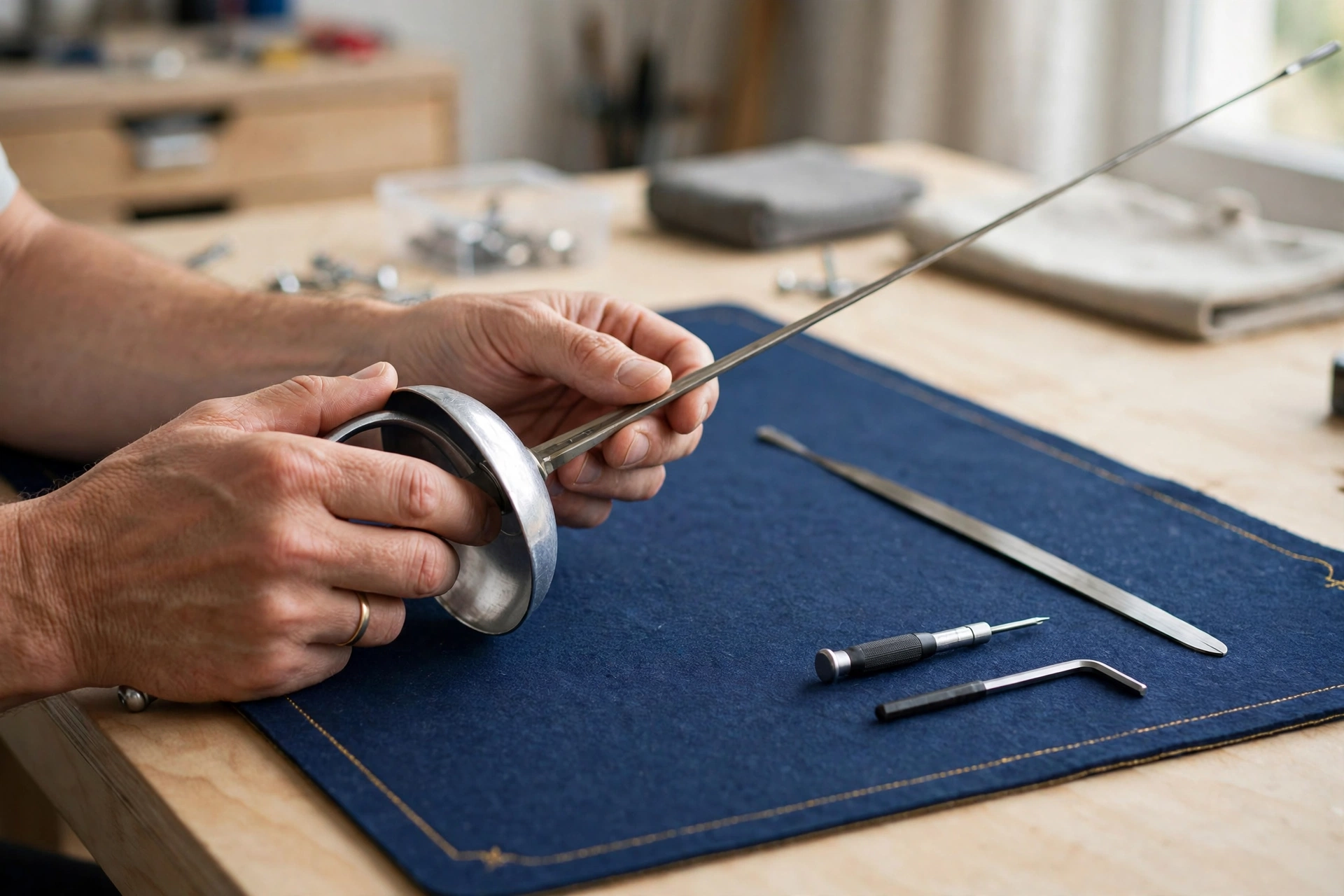
Blades eventually break or wear out, and the grip, guard, and hardware are usually still fine. Reblading means fitting a new blade to the existing parts. In outline: unscrew the pommel, slide the grip, guard, and socket off the old blade’s tang (the short metal stem inside the grip), thread the new blade’s wire into the socket and along the blade, seat everything back in order, and tighten it down. On an electric weapon the wire has to sit correctly in the blade’s groove and connect to the tip — done wrong, the weapon simply won’t register.
Costs, roughly: a replacement practice blade is about $25–$45, a standard non-FIE electric blade about $40–$90, and an FIE maraging blade about $100–$180 (reference prices, prices vary by weapon and size). Check price on Amazon
Our honest advice for parents: have a coach, club armorer, or shop do the first reblade, and watch it happen. After that, many families do it at home. Two specific reasons to hand it over even later: pistol grips, because the tang often has to be cut to length for the grip — a cut-you-can’t-undo step; and any weapon where the wire or tip is misbehaving for reasons you can’t see.
Foil, Epee, Saber: What Changes
The routine above is the same for all three weapons, with small differences worth knowing:
- Foil has the lightest blade and the smallest tip. Its wires and tip screws are the most delicate, and it’s the weapon most likely to come home with a gentle bend.
- Epee blades are stiffer and heavier, bend less often, and the tip has visible tiny screws — if one is missing, that’s a coach-level fix, since a loose epee tip fails equipment check.
- Saber has no tip switch at all (hits register along the blade’s edge), so there is less to test — but saber blades are thin, bend and kink easily, and the guard’s insulation matters: a guard with worn-through insulation can cause problems at equipment check.
Storage: Where Weapons Live Between Practices
- Blade covers on. A simple plastic or fabric blade cover (about $5) keeps blades from nicking each other and poking through bag liners. Check price on Amazon
- In the bag, not loose in the trunk. A car trunk is the worst storage spot in the house: summer heat bakes grips and glues, cold damp nights invite rust, and a loose weapon slides around under everything else you throw in. Trunk-stored weapons come home bent and rusty — the single most common cause of both problems in this article.
- Dry before storing. If gear got rained on, stand the weapons up out of the bag at home until everything is dry. Steel plus trapped moisture equals rust spots by next week.
FAQ
How long should a blade last?
It varies enormously — weeks for an aggressive fencer, a season or more for a beginner. Bends and heavy use shorten life. Budget-wise, plan on blades being a consumable, like gloves.
My child straightened the blade and it bent again in the same place. Problem?
Yes — that’s the fatigue signal described above. Retire that blade from electric use and ask the coach to confirm.
Can a broken blade be repaired?
No. A snapped blade is scrap. Save the grip, guard, and socket for the reblade, and throw the broken blade away safely (tape the sharp end first).
The Bottom Line
Weekly two-minute check, gentle straightening for gentle bends, sandpaper and a whisper of oil for rust spots, a spare body cord in the bag, and weapons stored indoors with covers on. Everything beyond that — first reblades, pistol-grip tangs, mystery electrical faults — is a ten-minute conversation with the coach. That’s not a failure of DIY; that’s how fencing families have always done it.