Disclosure: This post contains affiliate links. If you buy through a link on this page, we may earn a small commission at no extra cost to you.
Sooner or later a coach will look at your child’s feet and say, “Those running shoes won’t last long here.” It is not a sales pitch. Fencing footwork — hundreds of lunges, hard stops, and quick direction changes on every practice — loads a shoe in ways that street and running shoes simply are not built for. Here is what is actually different about a fencing shoe, when a substitute is acceptable, and how to size a pair for a kid whose feet will not stop growing.
What Makes a Fencing Shoe Different
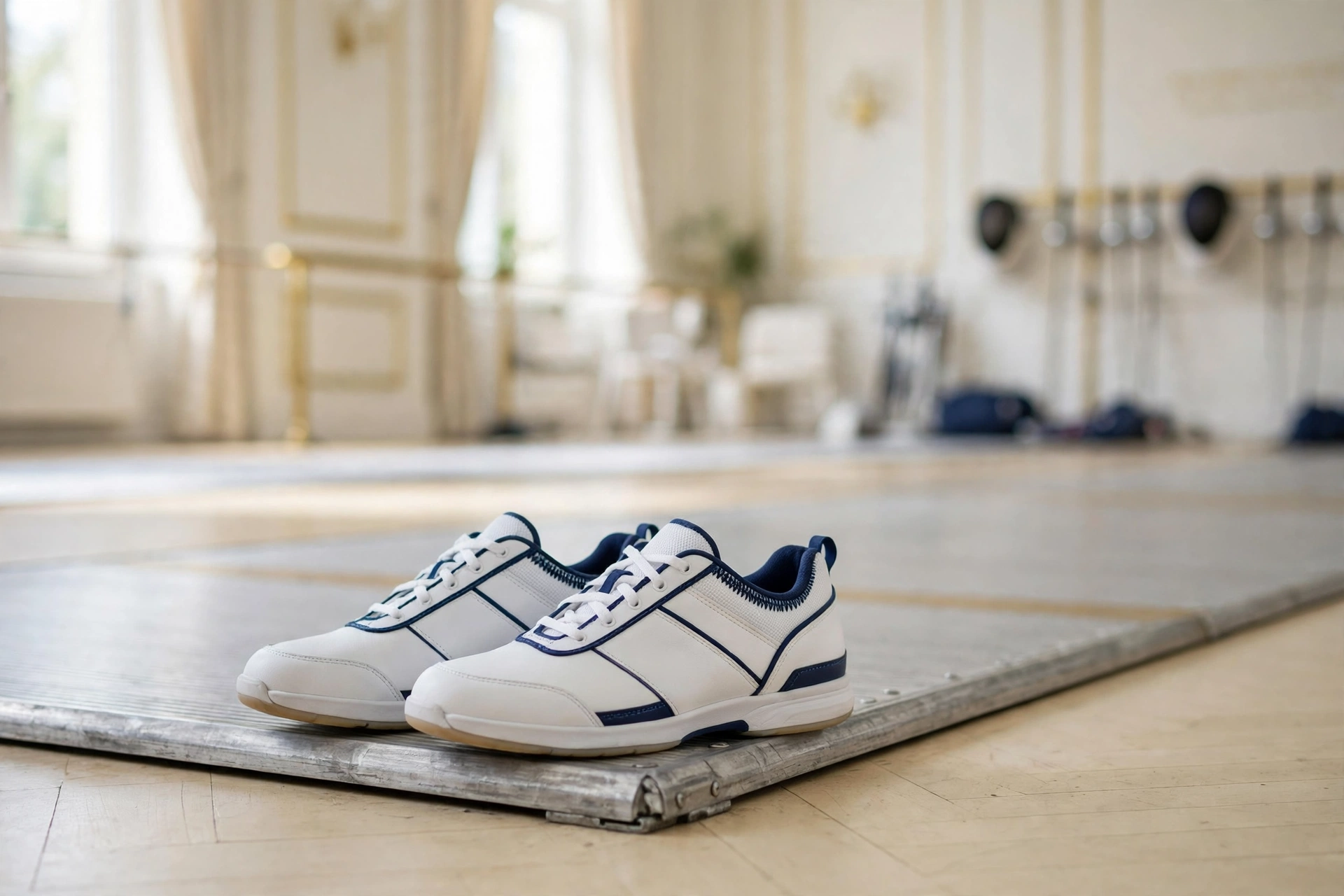
A thin, flat sole that stays close to the floor. Fencing shoes sit low, with a flat gum-rubber outsole that keeps almost the whole foot in contact with the strip. That low, stable base is what lets a fencer stop, change direction, and feel the floor. There is no thick foam stack and no raised heel like on a running shoe.
A rounded heel. Look at the back of a fencing shoe: the heel is curved, not squared off. On every lunge, the front foot lands heel-first and rolls forward. The rounded heel is shaped for that rolling landing, and most fencing shoes add a firm heel cup or extra cushioning inside the heel, because the lunge puts real impact through it.
Reinforcement on the inside of the foot. The wear pattern gives fencing away. Fencers drag the inside of the trailing foot along the strip as they lunge, and the inner forefoot takes constant abrasion. Fencing shoes add tougher material exactly there — around the inner toe and instep. On a regular sneaker, that same spot is thin mesh, and it is usually the first thing to tear.
A snug, low-cut fit. Fencing shoes are cut low and close so the foot does not slide inside the shoe during explosive footwork. Offset or protected lacing is common, because laces on the inside of the foot get dragged too.
Why Regular Shoes Fall Short
Running shoes are the most common beginner footwear — and the most common problem. They are built for straight-line motion: a thick, soft, raised heel, a curved toe, and tread that grips going forward. In fencing that raised heel makes the en garde stance and the lunge landing less stable, the soft foam lets the ankle roll on lateral moves, and the thin mesh upper wears through at the drag spot, sometimes within a season. Running shoes are fine for a trial class or the first few weeks. They are a poor plan for a child fencing twice a week.
Indoor court shoes are the accepted substitute. Volleyball, squash, and badminton shoes share the important traits: low profile, flat gum sole, lateral support. Many beginners fence happily in a court shoe like the Asics Gel-Rocket (about $75, reference price) for a season or more. If budget is tight, a court shoe is a much better stopgap than a running shoe.
Two things to avoid. Wrestling shoes look low and grippy, but they are made for padded mats and offer almost no heel cushioning for lunges on a hard strip — feet, knees, and backs complain quickly. And fashion sneakers styled after fencing shoes are street shoes; nothing in them is built for the strip.
The Main Choices, by Budget
Reference prices below were checked in October 2026; fencing gear prices move around, so confirm before ordering.
| Type | Examples | Reference price | Best for | Entry-level fencing shoe | Absolute Fencing AF Elite line, sold down to kids’ sizes | About $75–$80 | First real pair for a young fencer who will outgrow it | Indoor court shoe | Asics Gel-Rocket (volleyball shoe) | About $75 | Beginners not ready to commit to a fencing-specific shoe | Premium fencing shoes | Nike Ballestra 2 (list about $190; seen on sale at $159), Adidas D’Artagnan V (about $170), Kempa Attack Pro (about $199) | About $170–$200 | Committed fencers training and competing several times a week | Kids’ dedicated models | Kempa Attack Junior | About $80–$100 | Younger kids who need a real fencing shoe in small sizes |
|---|
One cost note: a sturdier shoe is not automatically the better buy for a child. A premium pair that gets outgrown in eight months loses to a basic pair that fits now — several fencing parents use the rule “a new budget shoe beats a worn-out premium one,” and for growing kids that logic holds.
Nike Ballestra 2 (premium pick). The most visible fencing shoe at US tournaments, light with a reinforced drag area and cushioned heel. Reference price: about $190 at list, and it does go on sale. Check price on Amazon
Adidas D’Artagnan V / Kempa Attack Pro (premium alternatives). Adidas’s current fencing shoe and Kempa’s top model both land around $170–$200. Stock in the US is thinner than Nike’s, so check fencing retailers as well. Check price on Amazon
Asics Gel-Rocket (budget substitute). A volleyball shoe, not a fencing shoe — but flat, grippy, and about $75. A sensible first season option. Check price on Amazon
Sizing for Kids: Buy the Size They Wear Now
Fencing shoes use ordinary US kids’, men’s, and women’s sizing — there is no special fencing conversion. The rules that matter:
- Do not buy a full size up “to grow into.” A fencing shoe that is too long lets the foot slide forward on every lunge. The result is blisters, sore or blackened toenails, and a sloppy landing. At most, leave about half a size of room.
- Measure both feet (they often differ) and check the specific brand’s chart — several popular models run narrow, so wide feet may need a different model rather than a bigger size of the same one.
- Expect roughly a size a year of growth for younger children, faster in growth spurts. Budget for a pair a year at elementary age; this is the real reason entry-level shoes exist.
- Squeeze the last bit of wear honestly. A slightly thicker fencing sock or an insole can bridge a few weeks, but once toes reach the end, replace the shoes — a too-small shoe hurts footwork as much as a too-big one.
- If you can, order from a retailer with easy exchanges. Kids’ fencing shoes are rarely stocked in local stores, so the first order is partly a fitting exercise.
FAQ
Can my child start in regular sneakers?
For a trial class and the first few weeks, yes — clubs expect it. Once they are fencing every week, move to a court shoe or an entry-level fencing shoe.
Do fencing shoes differ by weapon?
No. The same shoe works for foil, epee, and saber. There is no weapon-specific shoe to match.
How long should a pair last?
For a child, usually one season — either worn at the drag spot or outgrown. Adults fencing twice a week often get a year or more from a premium pair.
The Bottom Line
A fencing shoe is flat, low, rounded at the heel, and reinforced where the foot drags — running shoes are none of those things, which is why coaches push back on them. Start beginners in a court shoe or an entry-level fencing shoe in their current size, save the premium models for committed fencers, and plan on replacing kids’ shoes about once a year as feet grow.